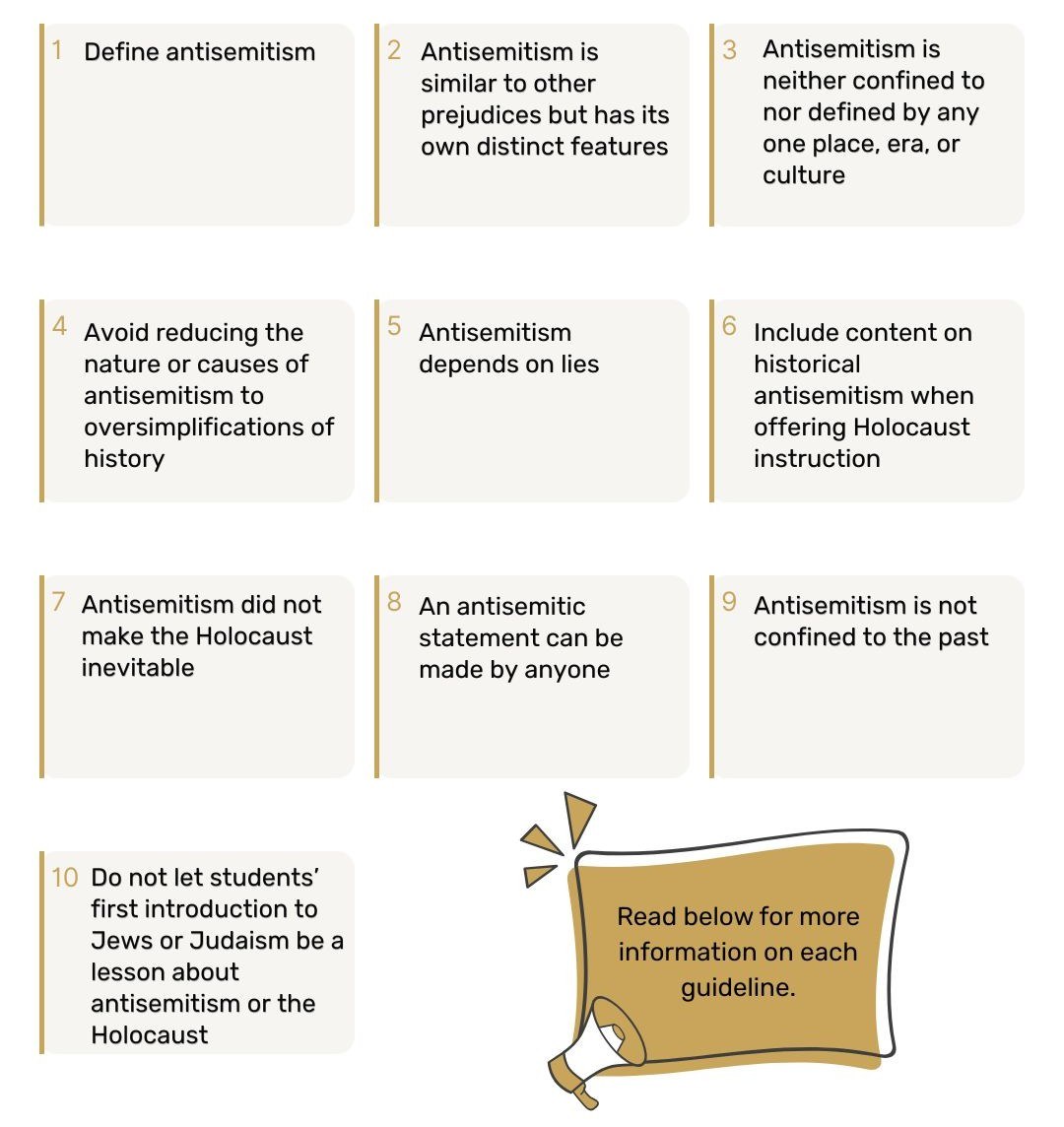
Define antisemitism
The state of Texas has adopted the IHRA definition, which is helpful for its identification of many of antisemitism’s key features.
Antisemitism is similar to other prejudices but has its own distinct features
Antisemitism morphs to fit attitudes in particular times and places, but certain patterns are apparent. These include the demonization of the Jewish people and religion and the association of them with the devil, the charge that Jews and Judaism are no longer relevant and have been replaced by Christianity or Islam, the accusation that Jews collectively participated in the murder of God, the dissemination of conspiracy theories accusing Jewish individuals and groups of secretly plotting to usurp power and harm innocents, the perception of Jews as clannish and traitorous aliens wherever they have lived outside of modern Israel, and more.
Antisemitism is neither confined to nor defined by any one place, era, or culture
Antisemitism existed long before Hitler, for example. Even during the Nazi regime, not all Germans were antisemitic, and not all Americans stood against antisemitism.
Avoid reducing the nature or causes of antisemitism to oversimplifications of history
Avoid reducing the nature or causes of antisemitism to oversimplifications of history, i.e., suggesting that Jews have been scapegoated simply because they were a minority or because they filled unpopular professions in certain times and places and therefore became associated with money. While these matters may have factored into increases in antisemitism, we must not ignore other, arguably more potent causes of antisemitism, including the Teaching of Contempt by the churches, the Blood Libel, the designation of Jews as a separate class during the Middle Ages, modern race theories, white supremacist movements, and more. The roots of antisemitism have tended to run deep and twist in complex ways.
Antisemitism depends on lies
Take time to teach that, like any conspiracy theory, antisemitism depends on lies, libels, exaggerations, fearmongering, stereotyping, dehumanizing, and propaganda, not sound evidence, to make its case.
Include content on historical antisemitism when offering Holocaust instruction
Show that antisemitism was the biggest factor behind how the Holocaust was conceived, planned, and implemented. While the Nazis indeed stole the property of Jews, the Nazis’ primary motivation was not greed, but hatred of Jews. Teach why Saul Friedländer and other scholars have called this hatred “redemptive antisemitism,” meaning that the Nazis promised it would save the world.
Antisemitism did not make the Holocaust inevitable
Develop students’ understanding that antisemitism, though widespread and longstanding, did not make the Holocaust inevitable. Perpetrators, bystanders, and the all-too-few rescuers and resisters made conscious choices that held deep ethical ramifications.
An antisemitic statement can be made by anyone
Be cognizant that an antisemitic statement can be made by anyone, including a Jewish person. When such a statement is made, it is usually best to try to focus on what makes the remark antisemitic, and not on the more dubious charge that the individual is an antisemite. (There are exceptions, of course, such as when the individual has an undeniable record of making this sort of statement.) Respond to antisemitic bullying and vandalism by building community awareness of the incident, reporting it to appropriate authorities, and educating about what makes antisemitism a danger.
Antisemitism is not confined to the past
Cite recent studies and news reports that demonstrate that antisemitism is not confined to the past; in fact, every major recent study indicates that antisemitic attitudes and crime rates are increasing at alarming rates around the world, including in the United States. Building students’ awareness of these facts helps them grasp that the lessons of the Holocaust remain timely, relevant, and important.
Do not let students’ first introduction to Jews or Judaism be a lesson about antisemitism or the Holocaust
Introducing Jews and Judaism in such a negative context gives the impression that the entirety of Jewish history is pitiable and creates the false impression that the Holocaust was inevitable. Although it is true that antisemitism has affected Jewish people across many generations, Jews should not be perceived as perpetual victims with no agency over their own lives. As is the case with other people, the experiences of Jews have been affected by many factors, including positive ones. Do not distort or trivialize Jewish lives by defining them in terms of only antisemitism or the Holocaust.
Printable version of THGAAC's 10 Guidelines for Teaching About Antisemitism